Feature
Conflicts Between Safety And Security
Aspects In Fire Design In Buildings
Ishita Jamal
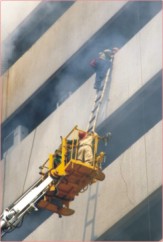 THE increased focus on security over the past several years has sparked heated debate between security and fire-safety professionals. These conflicts occur because while security must prevent intruders from entering a facility, fire-safety professionals must ensure that occupants can exit quickly in an emergency situation. THE increased focus on security over the past several years has sparked heated debate between security and fire-safety professionals. These conflicts occur because while security must prevent intruders from entering a facility, fire-safety professionals must ensure that occupants can exit quickly in an emergency situation.
While security technologies such as those governing alarms, CCTV, magnetometers, and similar equipment have evolved significantly in recent years, today's national building codes only address security issues related to basic locking arrangements that affect the building's means of escape system. Most of these requirements were developed many years ago and have not adequately changed to address today's advanced security and safety requirements.
Conflicts between security and safety often occur in the design phases of projects, ranging from perimeter security to exit stair locks. Several examples illustrate how well-intentioned design features can be conflicting, but more importantly they show how cooperation between the fire protection engineer and the security specialist can solve almost any problem.
Exterior perimeter security is the first line of defense in providing physical security for a building. The basic principle is to create a protective barrier either using natural or structural barriers around the perimeter of the building to restrict unlawful access to the site or to reduce vulnerability to vehicular traffic. However, unless designed properly, placement of these types of security barriers could adversely impact the ability of emergency vehicles to access the site, impede fire-fighter operations, or even interfere with movement/flow of occupants evacuating from the exit points of the building.
One such conflict involved the installation of a perimeter wall that impacted how the fire department accessed the building and key areas within the building. The fire department required multiple access points into the building; however, due to the installation of the wall, no access was available to allow the fire department to set up operations either at the main entrance or rear of the building.
Most of the concerns that occur between security and safety involve the second line of building defense, namely, the interior security controls within a building or the access control systems throughout the building. Building codes typically require access-control doors to be equipped with either occupant-detecting sensors or panic hardware that unlock these doors. Unfortunately, these safety precautions defeat the security objective, and security personnel typically object to these types of access-controlled egress doors.
Both the fire protection engineer and the security specialist can serve as ambassadors to all parties involved in the project to ensure the common goal of balancing safety and security, and that appropriate openness to the public is achieved. Based on past experience, it is extremely costly and very difficult to change an implemented security measure that is inadequate or, worse, not included when construction is underway or completed.
Understanding the perceived needs and the rationale of the security and safety issues is the first step towards a successful project. Throughout the design process, the design team must utilize engineering judgment rather than relying strictly on the requirements of the national codes and standards.
Addressing both life-safety and security is a difficult but essential task that requires knowledge of codes and their implications for the overall security plan. With the proper planning, we can find creative ways to work with the fire codes to create a win-win situation that ensures safety and security for all occupants.
(Writer is a student of M.Arch, Department of Architecture, Bangladesh University of Engineering and Technology (BUET), Dhaka.)
| 
